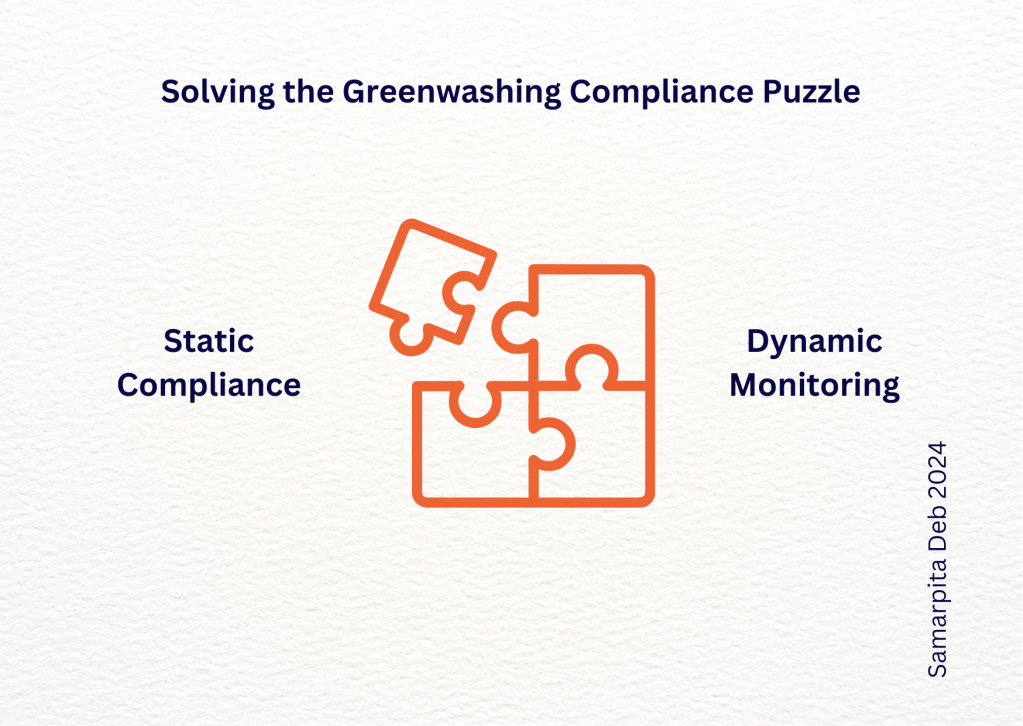
The greenwashing compliance landscape is very fast changing, unlike certain other areas of compliance where we can see that the law is more or less settled and is therefore much more static, making it more manageable. Traditional compliance approaches to greenwashing will therefore not work very effectively.
I see greenwashing compliance as a two pronged approach for the in house legal teams.
The first part of the compliance is the static compliance. This is the part where we work with our marketing and communications teams and ensure that the team can avoid the most egregious claims of greenwashing and complies with existing regulatory guidelines. But please note that this is not a fully static set-it-up-and-forget kind of compliance. This will also need periodical updating.
The second part of the compliance is the dynamic monitoring. This is the part where the legal team stays updated with evolving legislation and case law based jurisprudence that is happening in the jurisdiction. The information from the dynamic monitoring is used to update the static compliance as and when needed.
Here are some handy tools to help with the different approaches.
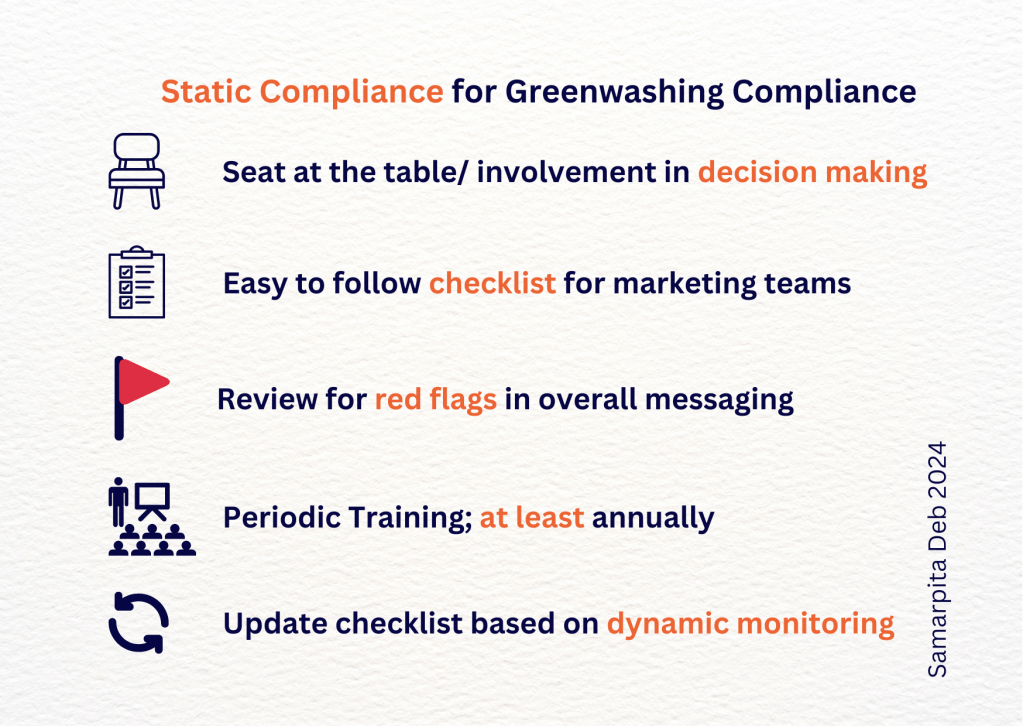
Static Compliance
First and most important, get a seat at the table of your company’s marketing decision makers. We must be aware that marketing and legal behaviors are diametrically different and in our work we cannot become a complete obstruction to the marketing team. But curbing enthusiasm in making factually false or misleading statements is something that needs to be challenged. Also this gives you a chance to catch the concerns early on. If money has already been spent in creating an advertising campaign, legal concerns will likely face far greater push backs. So early involvement is where you catch it.
Set up a checklist for the marketing team to follow. Having a quick check list can help the marketing teams in avoiding the most egregious claims. For creating this checklist, you will need to review both the current legislations in place in the jurisdiction, any industry specific regulations or recommendations, and ancillary legislations which can have a direct impact like consumer protection laws or laws against misleading advertisement.
Look out for generalized/red flag words like sustainable, green or greener, kinder, climate neutral, environment friendly etc. Dig deeper and ask for the basis of these claims and if they seem to be on shaky grounds, avoid. Someone, somewhere with enough resources and enthusiasm will notice.
Training, at least annually. Set up a training schedule at least annually for the marketing team. In this fast moving scenario, it is good idea to test annually where the teams stand with their understanding of what is greenwashing and bringing them up to date.
Update the checklist as often as needed. Some months you might not have anything to add, sometimes you will have a number of items to add. This is directly tied to what you distill from your dynamic monitoring.

Dynamic Monitoring
Google alerts. My most effective tool to keep up with changes in regulations and litigation. Set up one or multiple Google alerts with keywords that are relevant for your jurisdiction and industry. You can choose the frequency to be once per day or once a week. I would suggest that you set up once a week, because when we get an alert every day, sooner or later, we stop looking at those alerts and even though the landscape moves pretty fast, things do not usually change from day to day.
Keep track of ongoing litigation. My favorite is Sabin Center for Climate Change Law’s Climate Change Litigation Databases – Sabin Center for Climate Change Law. This is an excellent database from Colombia University, pretty comprehensive, and regularly updated with sufficient information available for you to monitor how the jurisprudence in moving in your country. Scan the litigation database maybe once a month and see what new judgments have come through and if there are something specific which then needs to be updated in your static checklist in a form that can be utilized by the marketing and communication and other client facing teams.
Law Firm Updates. Check out the major law firms in your jurisdiction and the websites they maintain. Many of them do have a ESG practice and they often update the websites with the latest changes that are happening. I find it useful to subscribe to such newsletters because the law firms do a very good job in summarizing rather complicated judgments and legislations in bite size, actionable articles.
Norms based research for continuous self due diligence. This is not a term that you will often hear but norms based research especially, in the ESG field is an invaluable tool for the general counsel. Norms based research involves analyzing data and practices against established norms, standards, or benchmarks. In ESG context, norms based research often focuses on comparing a company’s policies and actual practices with internationally recognized norms like those set by the UN Global Compact or OECD guidelines. This research identifies gaps or risks when companies do not align with these standards, enabling stakeholders to assess potential ethical, reputational, or regulatory concerns. A major risk of greenwashing is the risk of litigation. If you find yourself in a litigation situation it is likely, the opposition has substantial proof that the company is saying something and doing something else, thereby rendering the communication claims as greenwashing. So it is better if you can run a constant self due diligence to ensure that the company’s action and messaging are aligned.
Stay informed,
Samarpita
All opinions are personal



 ESG for Lawyers
Leave a comment