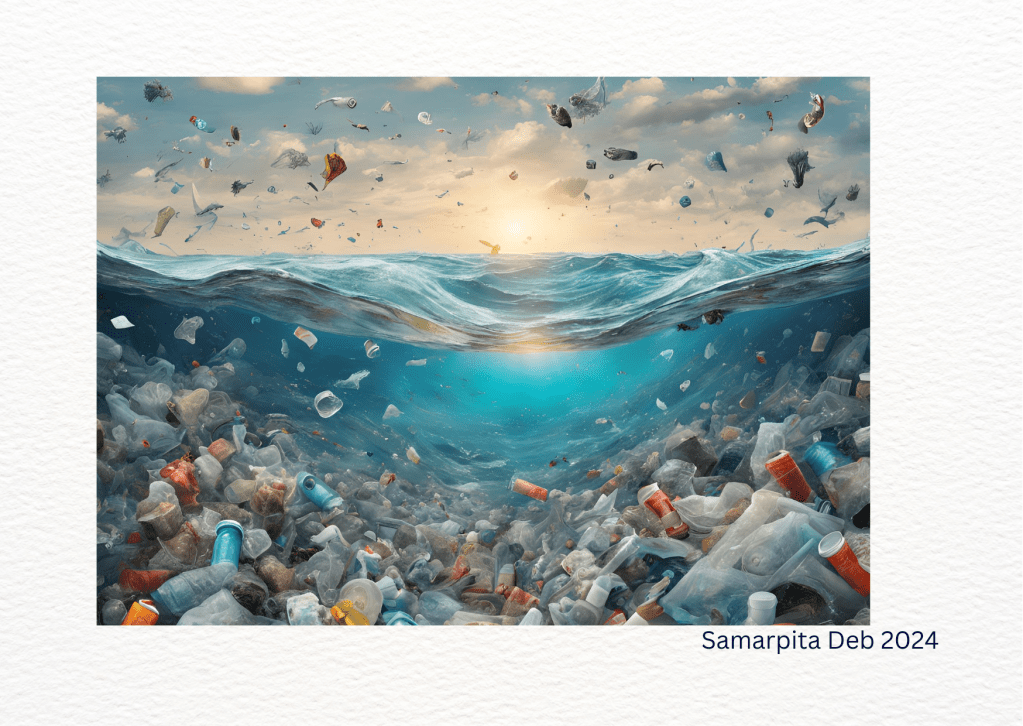
Plastic is everywhere—on Mount Everest’s peak, in the depths of the Mariana Trench, frozen in Arctic snow, coursing through our bloodstreams, and even present in breast milk.
We are living in a world drowning in plastic, a crisis of our own making. Even if we stopped producing new plastics today, the billions of tons already created would linger for centuries, poisoning ecosystems and infiltrating our lives in unimaginable ways.
Is there a way out of this nightmare?
In 2022, 170 nations backed a historic UN resolution to end plastic pollution, with a legally binding treaty promised by 2024. Yet, as of December 2024, negotiations have faltered, leaving the world at crossroads.
All is not lost, the negotiations will be picked up in 2025, so there is still some hope for a resolution to this plastic menace.
I was of course extremely disappointed at the outcome and decided to delve in to why the negotiations failed. As always issues like this are complex and multi-faceted, but I have tried to disentangle the Gordian Knot to make it more understandable for the rest of us who have an interest in the subject but probably not a lot of time.
Here we drew the battle lines
The main fault lines happened around the wording of Article 6 on whether there should be a commitment to cutting how much plastic is produced, or just try and reduce plastic waste by increasing efforts to recycle.
On one hand, we have the High Ambition Coalition, a coalition of around 95 countries who want to develop a international legally binding instrument that ensures urgent action and effective interventions along the full life cycle of plastics. Their ambition is to end plastic pollution by 2040.
On the other hand, we have several petrochemical-producing nations, who have strongly opposed efforts to reduce plastic production due to economic concerns.
One of the key nations who opposed the current version of the text is India.
India’s negotiators were and continue to remain concerned that reducing plastic production would affect its development right since plastic is crucial for many industries Instead, India called for better waste management and financial help for developing nations to improve recycling infrastructure.
But, is this position backed by data?
Statistics tell 39% of the story
According to a study published in the Nature, India is the highest emitter (9.3 Mt/year) of plastic emission in the world, followed by Nigeria (3.5 Mt/year) and Indonesia (3.4 Mt/year). China (2.8 Mt/year) which used to the world’s highest plastic polluter is now ranked fourth showing the progress in adopting waste incineration and controlled landfill.
But wait, this is only part of the whole story.
China, the world’s fourth largest absolute emitter, ranked 153 of all countries on a per-capita basis, and India, the world’s largest absolute emitter, is ranked 127 on a per-capita basis. Interestingly Russia, the world’s fifth largest emitter on an absolute basis, also has high emissions on a per-capita basis because it is reported to have very low levels of controlled disposal.
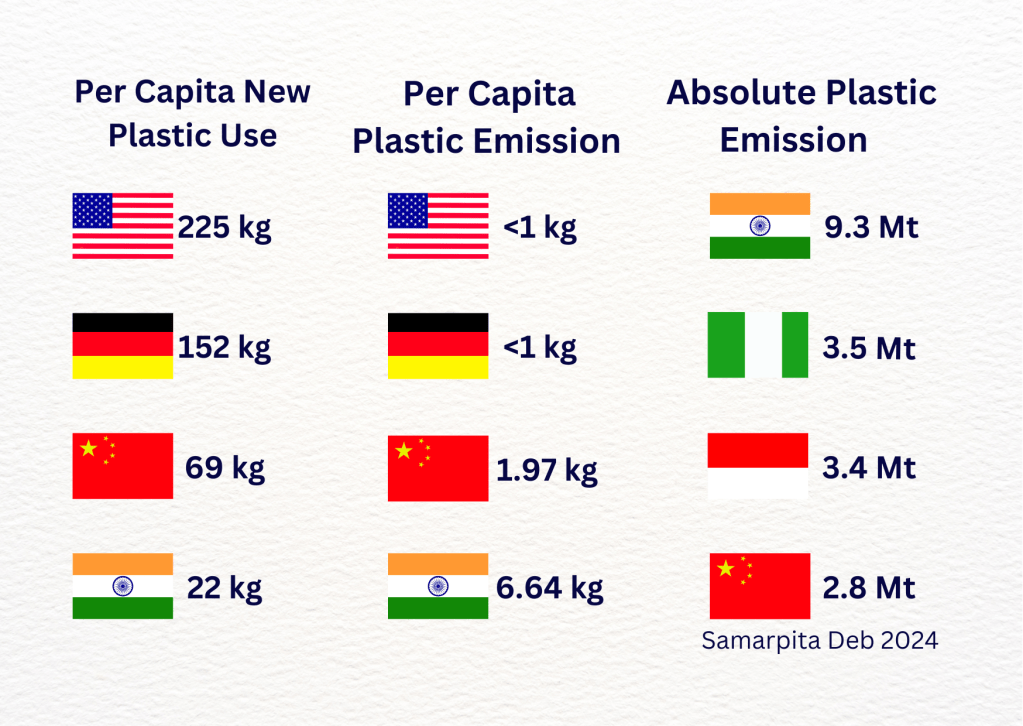
What about new plastic usage you ask. This is where the difference between the Global South and Global North becomes extremely stark.
According to OECD’s Global Plastics Outlook published in 2022, usage of new plastic per person is 225 kg in the United States, 152 kg in European OECD countries, 69 kg in China, and a measly 22 kg in India
The contrast between the absolute plastic waste emissions from the Global North and the Global South is largely driven largely by the poor waste collection methodologies in the Global South.
So, India’s position was not entirely wrong and is actually backed by data.
But even then, recycling is not the only solution. Recycling has to be accompanied by reduction.
Money talks but who is counting the externalized costs?
There is also large amounts of money and livelihood involved in this mix.
According to Mordor Intelligence’s plastic industry market size estimation, in 2023, the Indian plastic industry was valued at approximately USD 43.68 billion and is projected to grow to USD 68.33 billion by 2030. It also provides employment to over 4 million people and encompasses more than 30,000 companies. And that is just India. Several other countries in the Global South are looking at a fast growing plastic industry that generates both jobs and is critical for several industries including health care and food.
But, as always, there is a catch. This math of job generation does not take in to account the costs of plastic that we are paying as a world, be it land pollution, marine pollution, or microplastic following through our blood.
One who holds the wallet also has the microphone
In addition, there was a substantial amount of lobbying from several large petrochemical companies and interest groups. InfluenceMap examined 311 incidents of corporate communications(across a range of channels including consultation responses, media interventions, company statements and social media) on the UN Global Plastics Treaty since March 2022 and found 93% of unsupportive statements made by companies and industry associations to have come from the chemical and petrochemical sectors.
Many of these interest groups called for governments to prioritize recycling measures and opposing provisions to reduce the production of harmful plastics.
Is the petrochemical narrative founded on science though?
Chemical and petrochemical companies and industry associations in the plastics value chain employ two main narratives. As with many other lobbying efforts, none of the narratives is entirely untrue. But they leave out key details.
Claim 1 – plastics have a lower environmental footprint compared to other materials.
Fact check by InfluenceMap – This narrative fails to acknowledge the scale of plastic production’s impact on climate change. IPCC states that current trajectories point towards doubling of plastic production by 2035 and tripling by 2060. Aligned with that, oil and gas feedstock demand for chemicals will rise, which does not align with scientific recommendations on necessary GHG emissions reductions to stay within 1.5°C.
Claim 2 – plastics are essential for the energy transition and limiting their production or banning certain types could jeopardize climate objectives.
Fact-check by InfluenceMap – While the IPCC recognizes that plastics can help reducing emissions in certain other sectors, recycling rates remain extremely low due to various problems surrounding collection, contamination, technology and others. Hence, relying on recycling only will not solve the crisis. We need to be talking about reduction of production, product redesign, circularity among others.
Industry support matters
The consumer goods and retail sectors have strongly supported an ambitious science-aligned UN Global Plastics Treaty, forming a coalition that has promoted upstream solutions such as the elimination of problematic plastic materials and chemicals of concern, better product design, and scaling of reuse and refill systems.
The Business Coalition for a Global Plastic Treaty was launched in September 2022 with over 80 organizations including businesses from across the plastics value chain, financial institutions, and NGOs.
The open letter from the CEOs
In fact, before the negotiation started, a group of more than 20 CEOs from some of the world’s largest companies called on governments to agree to global binding roles to address the issue of plastic pollutions.
Interestingly one of the key points noted in the open letter is “A treaty based on voluntary measures alone risks delaying action by decades. This would create further fragmentation in the regulatory landscape for business, leading to increased cost and complexity.”
The CEOs asked that we reach agreement at INC-5 on:
- Global criteria and lists that enable the restriction and phase out of chemicals of concern as well as problematic and avoidable plastic products.
- Sector-specific approaches and global criteria for circular product design of plastic products, such as packaging.
- Common definitions and key principles for the effective implementation of Extended Producer Responsibility (EPR) schemes.
- A strong mandate for the governing body to strengthen the agreement over time.
This is important to undertake product redesign and have a uniform set of rules applying.
What is next? What can we do?
There will be a INC 5.1. may be even more INCs. We need to acknowledge that we will need a multi-pronged approach if we want a just transition.
We want a world that is not choking under plastic. And we also want a world where the people have a right to development.
At a global level, we need the largest consumers of plastic to reduce their usage while the countries with the largest emissions will need help with the technical and budgetary support they need to improve waste collection and recycling.
It is not reduce or recycle, it is both.
At a corporate level we need a radical rethinking of product design like replacing plastic sachets with refill centers so that daily necessities like shampoo or coffee or food does not get priced out of the hands of the poor.
We also need much better accountability of the plastic lifecycle from the key players, the producers, the government, the consumer product manufacturers, everyone in this chain.
At a consumer level, we need to demand better, from our governments, from companies, leverage every avenue we have, and ask for change. We also need to spread the message in social media and in our communities.
This is our crisis and we need to participate in solving this.
Success Stories
Germany’s concept of a deposit on drinks bottles ensures that barely any drinks bottle will reach the garbage bin. If you throw an empty bottle in the bin, someone will collect it. If there is money to be made, consumers will be willing participants in collection, recycling, refilling. Just give us the chance and see.
Technology also helps. China’s progress from the largest emitter to the fourth place shows the progress in adopting waste incineration and controlled landfill.
When is the right time?
Yesterday was best, but the next best time is today. The decisions made in the next few years will shape the planet for generations. Plastic pollution isn’t just an environmental issue; it’s a social justice and health crisis. Together, we can create a world that thrives without choking on plastic.
Stay informed,
Samarpita
All opinions are personal


 ESG for Lawyers
Leave a comment