
How can you upset a German? After finishing your beer, throw the bottle in the garbage bin. The bottle says it’s single-use, so tossing it in the bin seems like the correct action, right? Not in Germany.
In Germany, you’d be throwing away money. Why? Thanks to the country’s highly effective container deposit legislation, most beverage bottles – whether single-use or reusable – are returnable. The legal framework differs slightly between the two, but the result is impressive:
Germans return an astonishing 97–99% of single-use bottles and 99% of cans, ensuring they are recycled.
Compare this to 2003, when approximately 3 billion disposable beverage containers were dumped into the environment annually, according to the NGO Environmental Action Germany.
Germany has spent decades refining its regulations on bottle returns, offering valuable lessons for other countries looking to implement similar systems.
Reusable Beverage Containers
In Germany, there is no legal requirement for deposits or mandatory take-back systems for reusable beverage containers. Producers are assumed to have a vested interest in achieving high return rates to reduce costs and maintain sustainability.
Single-Use Beverage Containers
By contrast, single-use containers that require reprocessing after return fall under the Packaging Act (VerpackG), which replaced the Packaging Ordinance of 1991 in 2019. The Act mandates a deposit on single-use beverage packaging—currently set at 25 cents per container.
Pfandsystem
The deposit and recycling system, known as the Pfandsystem (Pfand = deposit), involves a complex yet efficient process. To manage this system, the German Retail Association and the Federal Association of the German Food Industry established the independent non-profit organization Deutsche Pfandsystem GmbH (DPG) in 2005.
DPG coordinates the entire deposit cycle, involving:
- Beverage manufacturers and importers
- Retailers and distributors
- Reverse vending machine manufacturers
- Sorting plants and label manufacturers
- Specialized ink users for marking
- Clearing service providers
What Happens to Recycled Material?
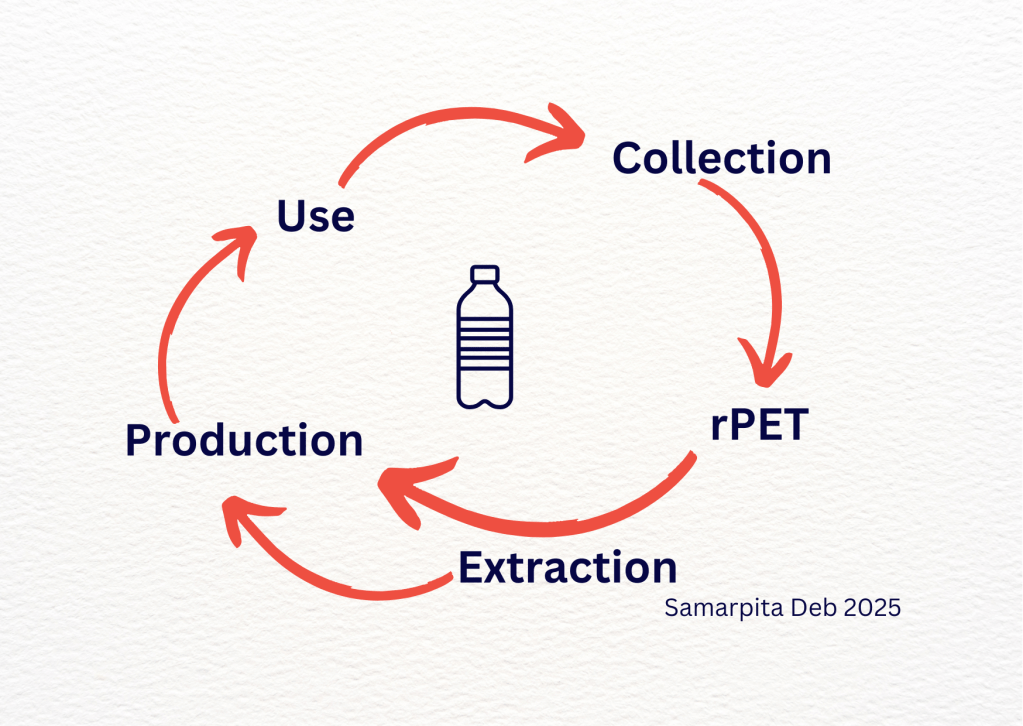
Recycled PET bottles (rPET) meet stringent food-grade standards, allowing them to remain in the food industry’s circulation system for as long as possible. This effectively transforms single-use PET bottles into a de facto multi-use system.
Beyond food packaging, rPET is also used in products like clothing and footwear. For example, I own two pairs of shoes made from knitted rPET material.
The Problem of Slippage (Pfandschlupf) and a Potential Solution
Not all deposit bottles are returned. When bottles are not returned, the deposit paid by customers at purchase is retained by manufacturers and retailers. In 2015, this “slippage” generated €180 million for bottlers and retailers, according to NABU (Nature and Biodiversity Conservation Union).
This additional income enables manufacturers to price single-use PET bottles lower than reusable ones, effectively subsidizing single-use products.
NABU has proposed a solution: redirecting the unclaimed deposit funds toward environmental and resource protection, similar to practices in Denmark.
Upcoming Changes
From 2025, all disposable PET beverage bottles must contain at least 25% recycled plastic (recyclate). By 2030, this requirement will rise to 30%, applying to all single-use plastic bottles.
The EU Plastics Products Directive also mandates that by 2029, 90% of single-use plastic bottles must be separately collected for inclusion in functional circular systems.
Reuse vs. Recycle
Despite Germany’s near-perfect return rates, reusing is still environmentally superior to recycling:
- Reusable glass bottles can be refilled up to 50 times.
- Reusable plastic bottles can be refilled up to 25 times.
- Single-use bottles, however, are recycled into recyclates and lose material quality with each cycle.
Additionally, producing these bottles often relies on fossil fuels, and virgin PET is still cheaper than recyclates. Mandatory recycled content requirements (e.g., 25% by 2025) will help improve recyclate usage but do not address the root problem.
Why not prioritize reusable bottles like glass or sturdier plastics? The answer lies in a mix of factors: regulatory challenges, consumer preference for convenience, and industry cost considerations.
Lessons for Other Countries
Germany’s success in reducing single-use bottle waste shows that with government pressure and well-designed incentives, mass participation is achievable. The system also generates jobs throughout the recycling process, which can serve as an added incentive for policymakers.
Could a similar approach work in Asia? What are your thoughts?
Stay informed,
Samarpita
All opinions are personal


 ESG for Lawyers
Leave a comment