A recent Eurobarometer survey found that 90% of Europeans believe stricter rules are needed for calculating environmental impact and related claims. This aligns with the European Green Deal’s commitment to tackle false environmental claims while accelerating the transition to a circular and clean economy, achieving climate neutrality by 2050.
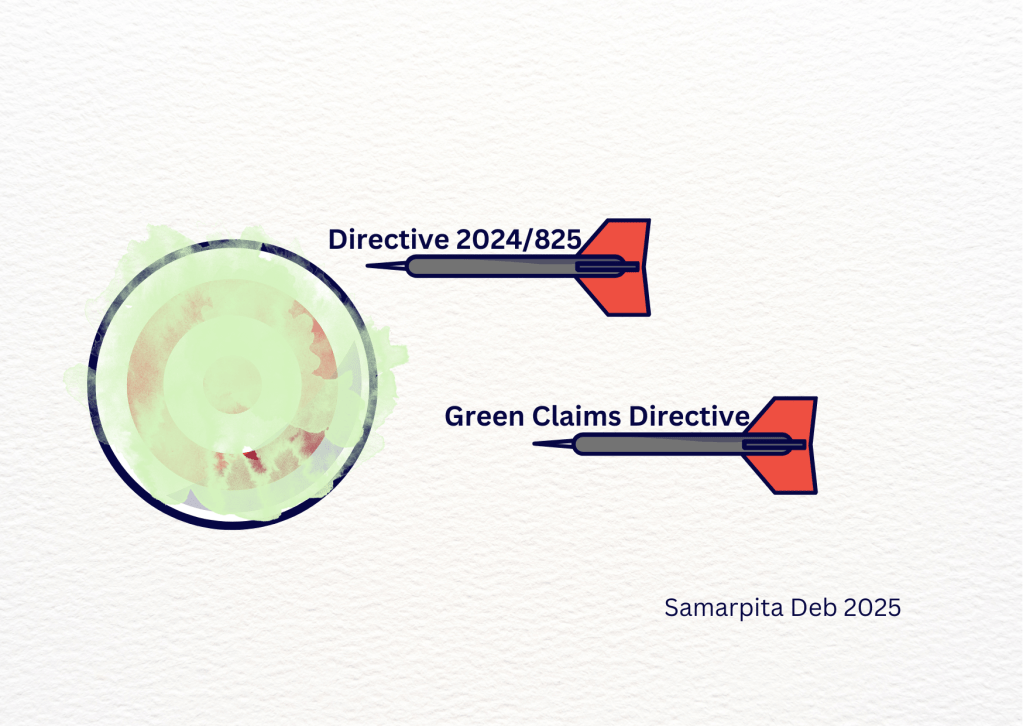
This is being undertaken with two distinct legal tools. The first one is the Directive 2024/825 which amends the Unfair Commercial Practices Directive and is already in force. The second, more expansive one will be the Green Claims Directive which is awaiting the first reading by the EU Parliament.
Directive 2024/825: Empowering Consumers for the Green Transition
Background and Timeline of Implementation
March 2022: The European Commission proposed updates to EU consumer rules to support the green transition.
September 2023: A provisional agreement was reached by the European Parliament and Council of Ministers.
January 2024: MEPs approved the agreement.
February 2024: The Council gave its final approval.
March 2024: The Directive was published in the Official Journal and enters into force.
March 2026: Deadline for Member States to transpose measures into national law.
September 2026: Measures become binding.
Key Provisions of Directive 2024/825
The Directive amends the UCPD (Unfair Commercial Practices Directive) 2005/29/EC by banning:
- Generic environmental claims on products without proof.
- Claims of a product having a neutral, reduced, or positive environmental impact based on emission offsets.
- Sustainability labels not based on approved certification schemes or established by public authorities.
Amendment of UCPD (Unfair Commercial Practices Directive) 2005/29/EC
The Directive updates the UCPD with the following:
- Definition:
A “generic environmental claim” refers to claims not included on a sustainability label and lacking clear, prominent specification on the same medium. - Broader Scope of Misleading Practices:
- Under Art. 6(1), claims with false information that deceive the average consumer about a product’s environmental characteristics.
- Under Art. 6(2)(d), unverifiable net-zero claims influencing consumer decisions.
- Under Art. 6(2)(e), irrelevant environmental benefits that do not arise from product features.
- Examples in Annex I:
- Displaying non-certified sustainability labels.
- Making unsubstantiated generic environmental claims.
- Claiming environmental benefits for an entire product or business when it applies only to a specific aspect.
- Stating that a product has a neutral, reduced, or positive environmental impact based on greenhouse gas offsets.
Connection to the Green Claims Directive
The Directive 2024/825 complements the Green Claims Directive, which is currently awaiting the European Parliament’s position in the first reading. The Green Claims Directive will establish:
- Minimum Requirements:
- Clear and evidence-based environmental claims.
- Third-party verification of explicit environmental claims and labels.
- Additional Obligations for Climate-Related Claims:
- Disclosure of the type and quantity of carbon credits.
- Differentiation between contribution claims (climate action) and offset claims (emission balancing).
- Proof of a net-zero target, progress toward decarbonization, and details of emissions offset.
Takeaway for Legal Teams and General Counsels
- Transposition.
Take note of the timeline for transposition via national laws in your jurisdictions and check for specifics under the national legislations. - Review Corporate Communications.
- Audit for generic environmental claims like “environmentally friendly,” “eco-friendly,” “green,” or similar terms. Ensure claims are backed by verifiable evidence of excellent environmental performance.
- Net-Zero Claims.
- Ensure net-zero claims are:
- Supported by clear, objective, publicly available, and verifiable commitments.
- Detailed in an implementation plan with measurable, time-bound targets.
- Regularly verified by independent third-party experts, with findings available to consumers.
- Ensure net-zero claims are:
- Third-Party Certifications.
- Consider adopting certifications like ISO standards to align with Directive 2024/825 and the draft Green Claims Directive.
- Prepare for increased reliance on third-party verifications for corporate communications.
- Avoid Claim Creep.
- Ensure environmental claims apply only to relevant aspects of the product or business. Avoid implications that claims cover the entire product lifecycle or business operations when they do not.
- Preparation for Audits.
- Develop robust documentation processes to substantiate claims, including:
- Evidence of environmental performance.
- Details of carbon credits and offsets.
- Engage third-party experts to verify claims proactively.
- Develop robust documentation processes to substantiate claims, including:
- Train Internal Teams.
- Educate marketing, legal, and compliance teams on the updated directives.
- Foster awareness of the risks of non-compliance, including reputational and financial penalties.
- Monitor Emerging Standards.
- Keep track of the Green Claims Directive’s progress and adapt compliance measures to align with anticipated requirements.
I also have a more general checklist here that can help you with creating your customized greenwashing compliance.
Stay informed,
Samarpita
All opinions are personal



 ESG for Lawyers
Leave a comment