
The key commodities driving tropical deforestation
Picking up from my last post where I looked at the ethical issues surrounding deforestation, I wanted to look in to further details as to what driving deforestation, beyond the headline figure of agricultural expansion as the primary driver, responsible for nearly 90% of global deforestation.
Turns out that Pareto Principle is at work here as well. The Pareto Principle, commonly known as the 80:20 rule, states that for many outcomes, roughly 80% of consequences come from 20% of causes (the “vital few”).
As it turns out, forest loss in the tropics is overwhelmingly concentrated to a small number of commodities.
In a seminal study by Florence Pendrill and colleagues published in Global Environmental Change, the resarchers quantified how much and where deforestation occurs from the expansion of croplands, pasture, and tree plantations (for logging) and what products are grown on this converted land.
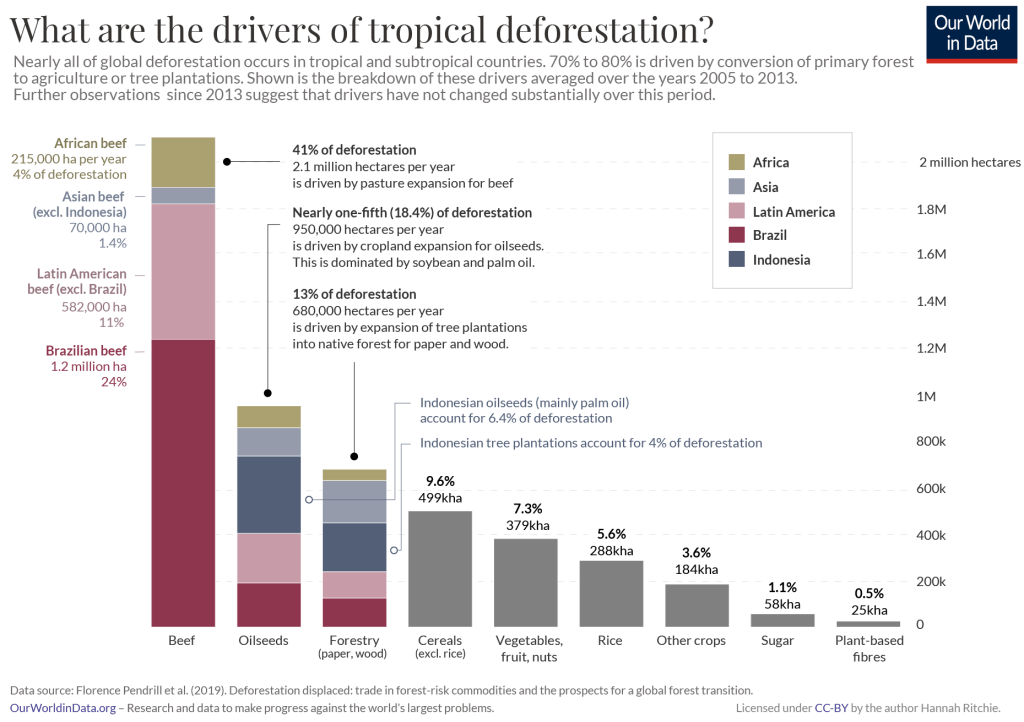
Cattle, oilseeds (soy and palm), and forestry products (timber and paper) are responsible for 75% of tropical deforestation, with pasture land for raising cattle responsible for 41% of tropical deforestation, about 2.1 million hectares each year.
In Brazil, about 72% of the deforestation is driven by cattle ranching. Cattle in other parts of Latin America, such as Argentina and Paraguay, also accounted for a large amount of deforestation – 11% of the total. Most deforestation for beef, therefore, occurs in Latin America, with another 4% happening in Africa.
Any discussion about cattle ranching will immediately raise the “what about” palm and soy question. To be clear, these two oilseeds are a massive problem too, together driving 18% of deforestation.
When I was living in South East Asia, driving for kilometers through oil palm monocrops was one of the worst sights, knowing what beautiful ecosystems have been replaced.
The soy nuance
Soy is often painted as the biggest devil of deforestation and I have had people who told me that they would rather eat beef than eat soy products because they do not want to participate in deforestation of the beautiful rainforests. But, for our actions to have actual impacts, we need to understand the data behind it.
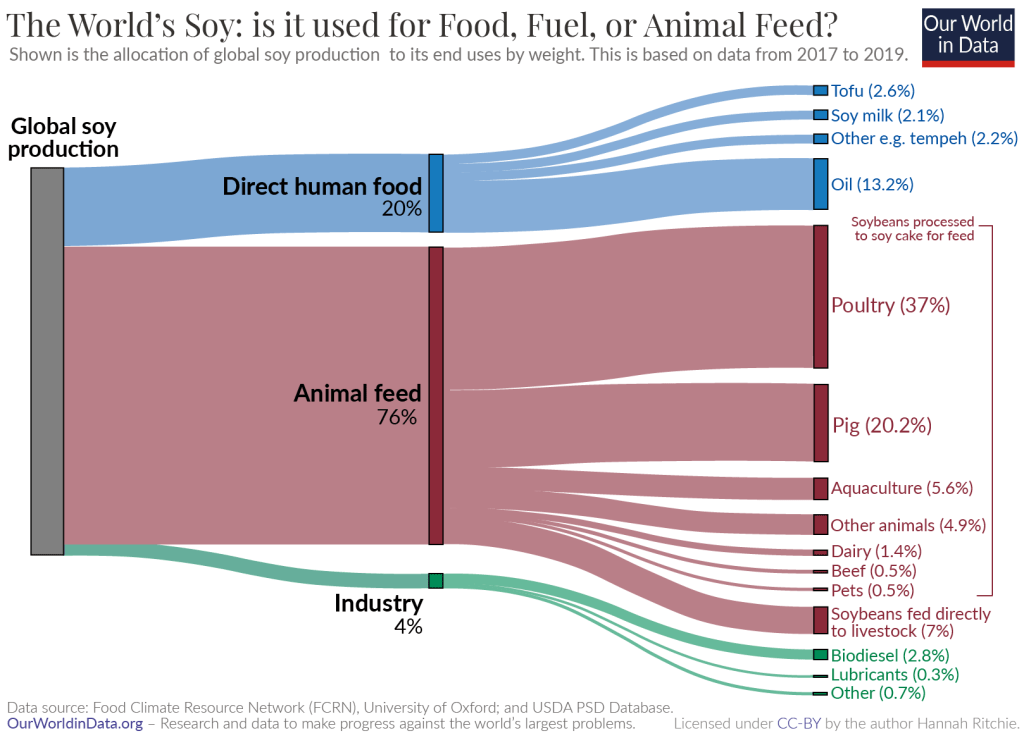
The problem with soy is nuanced, as usual, lost in the age of 3 second sound bytes. Just 6% of global soybean production is used for direct human food like tofu or soy milk. More than three-quarters (77%) of soy is used as feed for livestock.
There has been a huge increase in the use of soy for both production of soy oil for human consumption as one of the cheapest vegetable oils and the most valuable oilseed cake for animal feed.
So, can we argue that increases in the production of soy has been driven by the demand for soy oil for human consumption?
Crushing of soybeans produce about 20% by weight oil and 80% cake. One third of the overall value of a kilogram crushed soybeans is derived from the oil, versus two thirds from the cake.
That tells us that the financial incentive of soy as a cash crop is primarily derived from its use as animal feed.
Forestry products like timber and paper are the next big drivers of deforestation. In Europe and North America, these products mainly come from managed forests but in most tropical countries, the primary rainforests are the source of these products.
Across all commodities, the pattern is consistent: forests are cleared not for local consumption, but to supply global markets.
This is borne out by research as well, as the study from Pendrill et. al. states “for many developed countries, deforestation emissions embodied in imports rival or exceed emissions from domestic agriculture. Depending on the trade model used, 29–39% of deforestation-related emissions were driven by international trade.“
What the data shows: scale and geography of forest loss
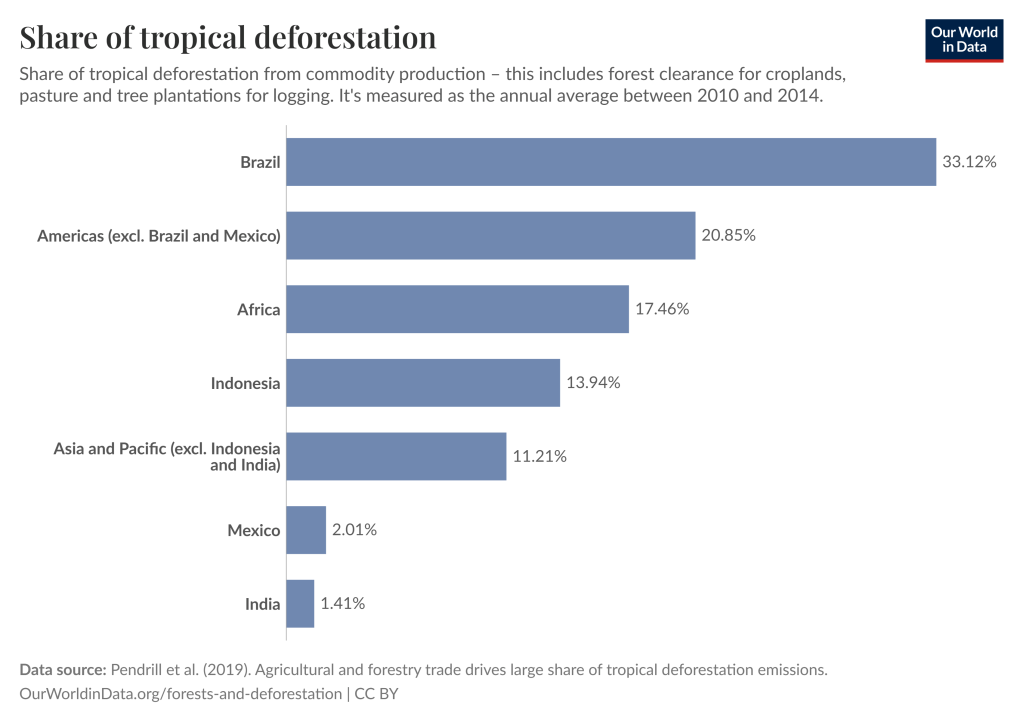
Using satellite data, researchers at Global Forest Watch estimate that annual global deforestation is around 4 million hectares, 95% of that in the tropics.
Brazil accounted for one-third of this massive number, followed by Indonesia, together totaling a depressing 47% of forest loss.
The EU’s deforestation footprint through trade
For European consumers and regulators, this raises an uncomfortable question: how much of this destruction is embedded in EU consumption?
Between 2005 and 2013, the EU caused more deforestation than any other country through its imports of agricultural commodities , with values well above 250,000 hectares per year (132 million tonnes CO2 per year), before being surpassed by China in 2014.
Between 2005- 2017, the EU accumulated 3.5 million hectares of deforestation (1,807 million tonnes CO 2) in its imports, representing 21% of deforestation associated with international trade of commodities over that period. In 2017, the EU accounted for 16% of global deforestation through its import of agricultural and forestry commodities.
In 2019, the EU Consultation for the EU Deforestation Regulation (EUDR) was a foundational step, stemming from the “Stepping up EU Action to Protect and Restore the World’s Forests”. 1.2 million EU citizens made submission to the EU’s public consultation on deforestation, demanding a strong EU law to protect the world’s forests. This was the largest public consultation on environmental issues in the history of the EU. The participants called for a strong, new EU law to keep products linked to deforestation and nature destruction off the European market, and ensure that the production of such commodities (such as beef, soy for animal feed, palm oil) do not led to human rights violations.
Impact assessment and commodity selection
In 2021, the EU Commission carried out a detailed impact assessment on the impacts of the various commodities that are entering the EU markets and their impacts on deforestation.
The impact assessment had some clear goals
- Reduce EU-consumption and production driven deforestation by 29% by 2030
- Save at least 72,000 hectares of forest every year starting 2030
- Prevent a minimum of 32 million metric tonnes of CO₂ emissions annually
- Generate economic savings of at least €3.2 billion per year
The assessment found some very clear indicators of where the focus should be as you can see in this image.
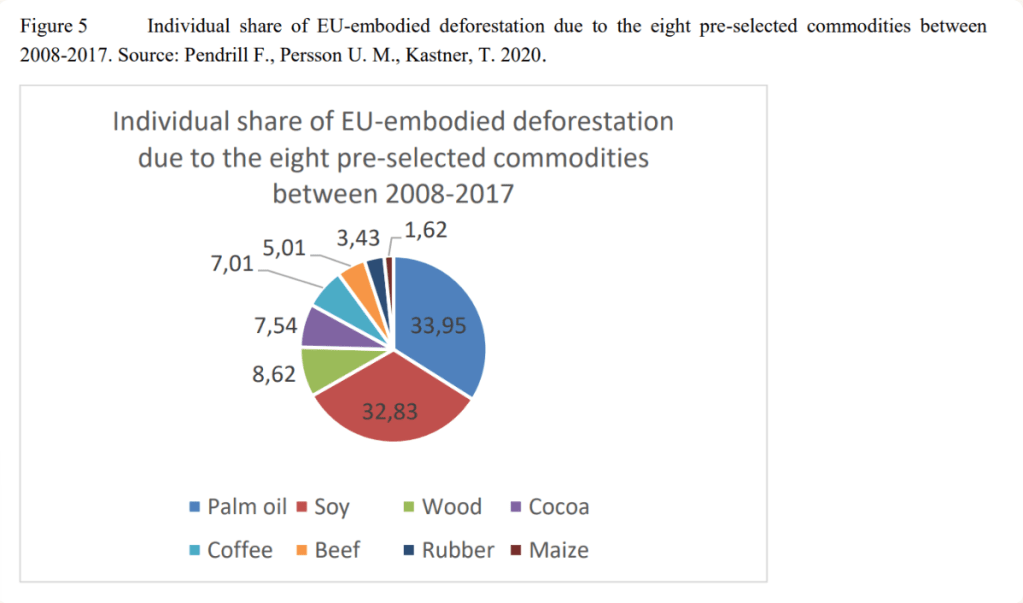
Cattle, wood, palm oil, soy, cocoa, and coffee were identified as the most relevant commodities.
It is very interesting to know that during the initial assessment, rubber was excluded from the list of commodities linked to deforestation, likely due to flawed or underestimated data on rubber’s deforestation impact. At the time, the available estimates of rubber-related deforestation were significantly lower than reality—sometimes by a factor of two to three—because they relied on models and extrapolations rather than high-resolution satellite data. This led to an underestimation of rubber’s role in driving deforestation, especially in Southeast Asia.
By 2023, however, new evidence and more accurate satellite mapping revealed that rubber was responsible for much more deforestation than previously thought. This, combined with pressure from NGOs and industry stakeholders who argued that excluding rubber would undermine the regulation’s effectiveness and harm vulnerable communities, led the EU to include rubber in the final EU Deforestation Regulation (EUDR).
The findings of the assessment report ultimately shaped the scope and structure of the EUDR as adopted in 2023, the topic of my next post.
Stay informed,
Samarpita
All opinions are personal

 ESG for Lawyers
Leave a comment